

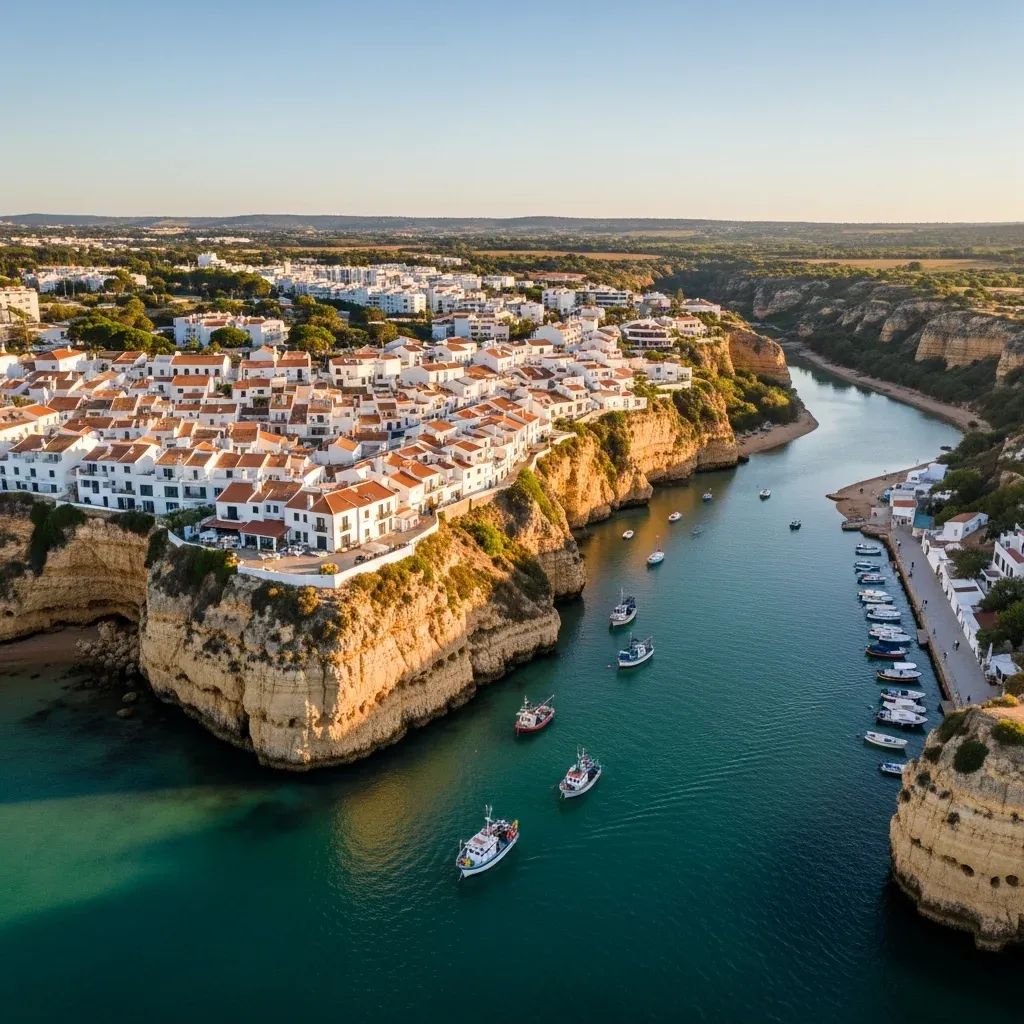
A cluster of whitewashed houses perched on a low cliff between Tavira and Vila Real de Santo António has become a laboratory for the Algarve’s future. Cacela Velha still counts barely fifty inhabitants, yet it must now juggle international accolades, a swelling tide of day-trippers, and a coastline that crumbles a little more every winter.
What matters in 2026
• Barely 50 residents share the village with thousands of seasonal guests.
• The headland retreats up to 4.5 m a year, forcing footpaths to close.
• Prémio Cinco Estrelas 2024 put Cacela on global wish-lists.
• €8.8 M regional plan aims to steer tourism toward sustainability.
• Authorities keep warning: Praia da Fábrica has no lifeguards and treacherous currents.
• New archaeological digs revisit the site’s Islamic-to-Christian transition.
A sentinel turned sanctuary
Long before holiday brochures discovered the eastern Algarve, Cacela Velha functioned as a watch-post overlooking the Guadiana estuary. The low fort, chapel and straight streets were designed for clear sight-lines, not commerce. Today the same geometry offers camera-ready vistas of the Ria Formosa Natural Park, a wetland recognised across Europe for its biodiversity. That dizzying view remains the village’s greatest asset—and its Achilles heel, because the cliff face is steadily eroding under Atlantic swells and shifting tidal bars.
Fifty neighbours, thousands of visitors
The parish of Vila Nova de Cacela registered 3 873 inhabitants in the 2021 census; the historic core houses roughly fifty of them. Yet on a sunny August weekend, ferries and small fishing skiffs can land ten times that number on the sandbank opposite the village. To keep the influx from overwhelming local life, the Algarve Tourism Board (RTA) folded Cacela into its “SustenTUR” green routes, which promote low-impact activities such as bird-watching and silent hiking. Residents, meanwhile, have drawn up an informal code that asks guests to respect siesta hours and to carry out all waste—there are no bins on the dune island.
Awards bring fame—and pressure
Winning the Prémio Cinco Estrelas Regiões in 2024 catapulted Cacela Velha onto international rankings usually dominated by Lagos or Albufeira. Travel writers hailed “possibly the best beach in Europe”, but locals remember the summer when 60 people had to be rescued from rip currents. The headland’s award plaque now sits beside a laminated notice from the Navy’s Maritime Authority warning that the crossing is dangerous, especially at ebb tide. With regional overnight stays rising 3.5 % in late 2025, the gap between marketing slogans and fragile reality keeps widening.
Erosion, currents and a beach without lifeguards
Scientists from the LIFE Ilhas Barreira project measure shoreline retreat here more closely than anywhere else on the south coast. The opening of a new tidal inlet in 2010 accelerated the loss of protective dunes; since then, authorities have periodically closed the path near the fort to let vegetation regrow. At the water’s edge the problem flips: sand is plentiful, but the lagoon becomes a funnel for powerful tidal jets. Despite repeated appeals, Praia da Fábrica remains an unconcessioned zone, meaning no watchtowers, no first-aid post, and no statistics on visitor numbers—only rescue logs.
Digging up the layered past
While the sea claws at the outside, archaeologists are peeling back the inside. A four-year campaign led by the University of the Algarve and Simon Fraser University is mapping occupation between the 10th and 15th centuries. Trenches behind the chapel have already revealed an Islamic cistern, glazed pottery from Seville and evidence of a hurried Christian refortification. The local heritage centre, CIIPC, turns each summer dig into open-air classrooms where school groups learn how lime wash protects stone walls from salt spray.
Funding the next chapter
Lisbon’s new Environment Minister, Maria da Graça Carvalho, wants the eastern Algarve to be the test bed for the “renaturalisation of barrier islands”—an ambition that dovetails with the national PACS-2025-14 fund earmarking €65 M for coastal defence. For Cacela, that could translate into selective dredging, sand nourishment or even removing the car park that currently sits on the eroding cliff top. Until then, the village’s best defence remains its own restraint: no hotels, no neon, and a collective willingness to keep the scale small even when the spotlight is glaringly large.


