
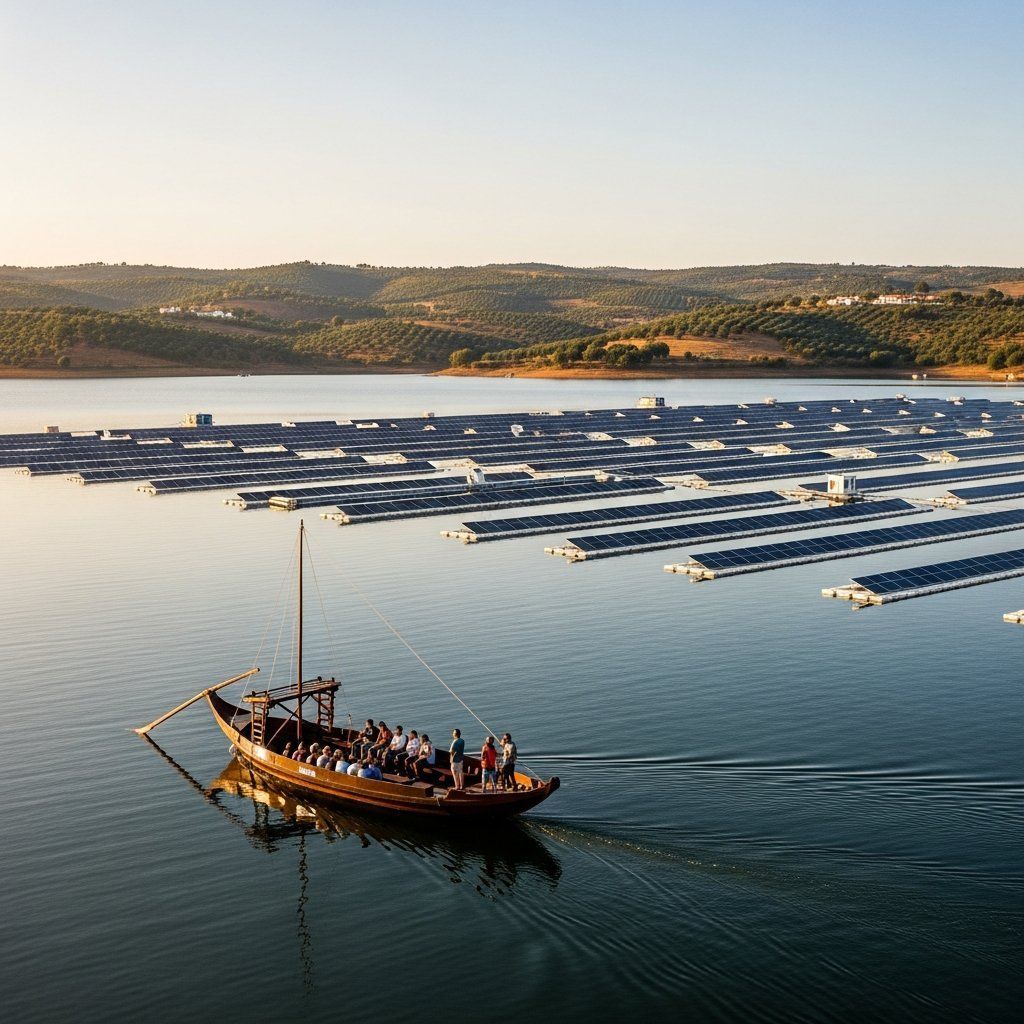
For visitors who have sailed the mirror-smooth waters of Alqueva, the idea of skimming past thousands of gleaming panels rather than open sky feels jarring. Yet for Portugal’s energy planners, those same panels could power tens of thousands of homes and push the country another step toward its 100%-renewable ambition. That tension—between clean-energy rollout and tourism-driven livelihoods—came to a head again this week as five Alentejo councils took their fight against EDP’s planned 70 MW floating solar farm to Lisbon.
What’s at Stake — in 90 Seconds
• 70 MW project would multiply by 14 the floating capacity EDP already operates on Portugal’s largest reservoir.
• Local mayors warn of lost nautical tourism, obstructed navigation and a "wall of panels" spoiling the landscape.
• EDP argues floating PV will cut water evaporation, use existing grid links and create construction jobs in the region.
• The Portuguese Environment Agency (APA) is now the forum for the next round of arguments, with licensing still open.
• Decision expected in early 2026; work could start the same year if approvals land.
A Sunshine Nation Looks to Its Lakes
Portugal’s sprint toward net-zero relies increasingly on space-saving technology. Wind potential is largely tapped, onshore solar farms face land-use battles, and offshore projects need time. Enter floating photovoltaics (FPV)—an idea first tested here in 2017 at Alto Rabagão and showcased globally when EDP unveiled a 5 MW pilot at Alqueva in 2022. The company claims panels cooled by water produce 5-15 % more electricity than ground arrays and avoid competing with farmland.
Why Alqueva Matters Beyond Megawatts
Built in 2002, the Alqueva dam created Western Europe’s largest artificial lake, stretching 250 km of shoreline across Beja and Évora districts. Over two decades it has nurtured small-scale marinas, Blue-Flag inland beaches and a growing network of rural guest houses. Although hard numbers are sparse, regional authorities cite a record 3.2 M overnight stays in the wider Alentejo last year, with water sports ranked as a top draw for high-spending visitors from North America and Scandinavia.
Mayors Push Back: Navigability vs. Kilowatts
During a closed-door meeting in Lisbon, mayors from Moura, Reguengos de Monsaraz, Portel, Alandroal and Mourão told Environment Minister Maria da Graça Carvalho that 40 ha of floating hardware near Moura alone would carve up cruising lanes and erode the lake’s tranquil image. Reguengos mayor Marta Prates warned that “a lake filled with panels" conflicts with the premium, nature-focused tourism the councils have banked on. Her counterpart in Moura, Álvaro Azedo, added that profits “flow straight to Lisbon headquarters, not to local budgets.” None of the five towns report having been formally consulted during project design.
What the Numbers Show on Water-Based Tourism
Direct statistics remain patchy, yet signals are clear:
• Marina da Amieira logged a 22 % rise in boat rentals between 2021 and 2024.
• The new Praia do Lago near Moura, opened 2024, hit full capacity on 37 summer days.
• The Moura-Alqueva Nautical Station reached the finals of the 2025 National Tourism Awards in the "Blue Tourism" category.
Local entrepreneurs fear even a partial navigation exclusion zone could slacken that momentum during peak season, when hospitality and boat hires make up to 40 % of annual turnover.
Lessons From Europe’s Other Floating Farms
Experience abroad offers a mixed picture:
• Dutch reservoirs hosting 27 MW to 41 MW FPV arrays reported no significant change in flora or fauna after three years of monitoring by BayWa r.e.
• In France, the 74 MW Les Ilots Blandin installation required a visual-impact buffer to safeguard a regional nature park.
• Portugal’s own Cabril dam project was shelved after APA flagged irreversible landscape impacts.
Positive takeaways include evaporation cuts of up to 60 %, soil-use savings and quick plug-in via existing hydropower lines. But each success story hinged on extensive environmental baselines and community buy-in—two elements Alqueva’s critics say are still thin.
Can Compromise Float?
EDP has floated several mitigation ideas: trimming the array footprint, guaranteeing a free-sailing corridor, funding a lake-wide environmental monitor, and offering a slice of feed-in revenue for local development funds. Mayors counter that meaningful gains would require per-kilowatt royalties and joint planning of tourist corridors before anchors hit water.
Environmental lawyers note that Portugal’s updated Renewable Licensing Law allows the state to impose “territorial compensation” on large green-energy ventures—an option the Alentejo bloc is now exploring.
The Road Ahead
APA’s technical opinion is due “within months,” after which the project could face a public consultation phase. If the agency rules that the 70 MW farm is “without significant adverse impact,” construction contracts may be issued by autumn 2026. Should the verdict be negative, EDP would need to redesign—or abandon—its flagship expansion.
Whatever the outcome, Alqueva now stands as a test case for how Portugal balances its renewable-energy race with the equally prized tourism economy that keeps many inland communities afloat.
Key Takeaways for Residents and Investors
Expect a final environmental ruling in 2026; until then, no panels are added.
Tourism operators should plan for both scenarios—status quo or restricted routes near Moura.
Local councils aim to negotiate compensation; a lake-wide development fund is on the table.
For EDP, Alqueva is a showcase project; for Alentejo, it could become a cautionary tale—or a model of coexistence.


