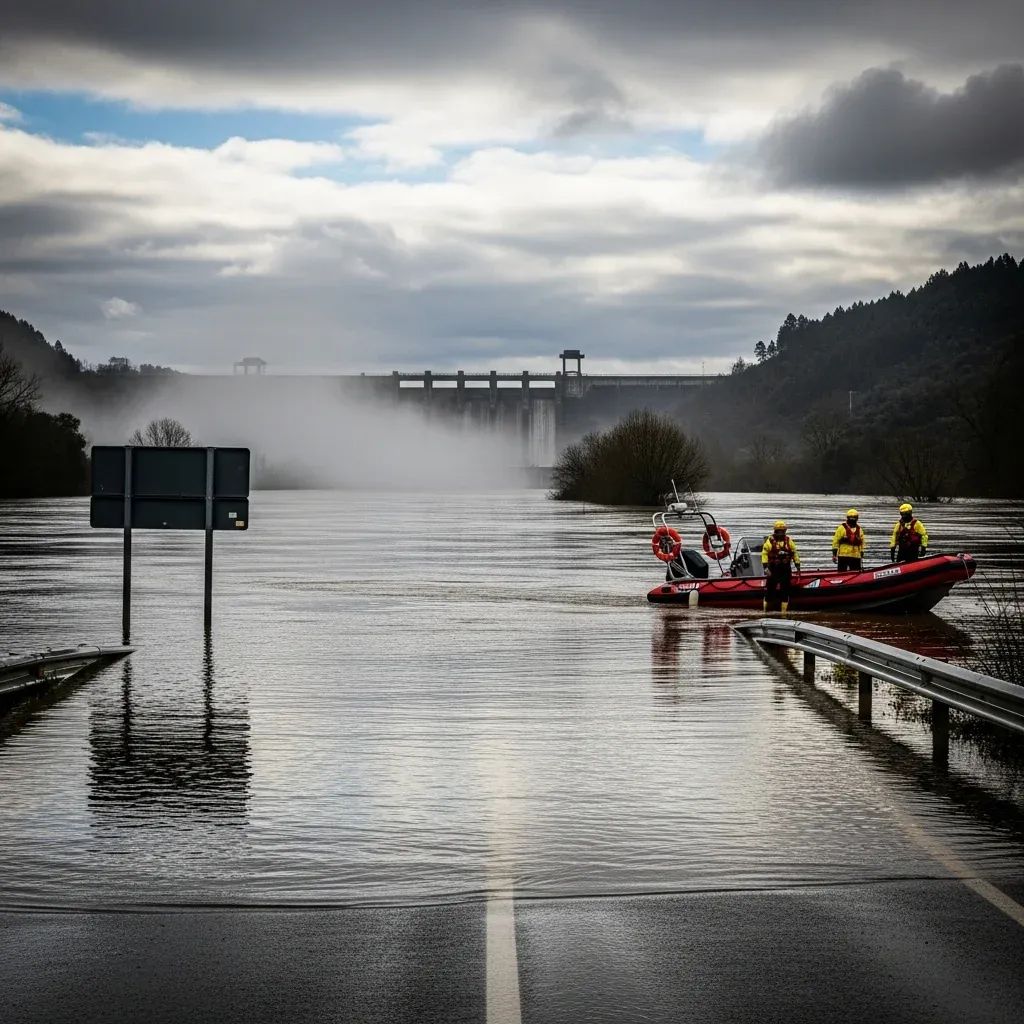
The Portugal-run Alqueva reservoir is now releasing water at 3,300 m³/s, a torrent capable of filling an Olympic-size swimming pool every 2 seconds and keeping the Guadiana River within its banks after weeks of torrential rain.
Why This Matters
• Navigation halted: river traffic between Mértola and the Spanish border remains suspended until currents slow.
• Flood-plain alerts active: municipalities in the Baixo Guadiana keep roads closed and sirens on standby.
• Electricity boost: extra turbining at Alqueva and Pedrógão is adding gigawatt-hours to the grid at a moment of soaring wholesale prices.
• Water for summer crops secured: a new government order lifts the annual allocation for irrigation from 620 hm³ to 730 hm³, cushioning farmers against the next drought.
From Relentless Rain to Record Outflow
Southern Portugal has endured one of the wettest January–February periods since 2001. Satellite gauges show the Guadiana basin receiving triple its seasonal average, sending inflows into the 250 km² albufeira at more than 3,000 m³/s overnight on 1 February. With storage nudging 100 %, the state-owned EDIA – Empresa de Desenvolvimento e Infraestruturas do Alqueva – opted to reopen the mid-level spillways for the first time in 13 years. Outflow started at 600 m³/s and was stepped up in stages to the current 3,300 m³/s after a 48-hour pause proved the lake would otherwise overshoot its safety crest.
How the Controlled Releases Work
Unlike emergency dumping, a controlled release mixes two channels:
Hydropower turbining – now running at its 800 m³/s limit, feeding both the national grid and the reversible pumping scheme that balances renewables.
Mid-level spillways – opened incrementally to absorb fresh inflows while avoiding a single violent pulse downstream.
Every cubic metre that leaves Alqueva enters the Pedrógão dam, where a second adjustment is made before the Guadiana flows free toward the Algarve and Andalusia. That twin-dam choreography keeps flood crests low enough for levees built in the 1990s to cope. The procedure adheres to the APA safety protocol and the External Emergency Plan updated after the 2010 flood scare.
Safety First Along the Guadiana
Local protection-civil units have posted red flags at quaysides, closed riverfront car parks, and advised residents to secure farm machinery on higher ground. The Capitania de Vila Real de Santo António warns pleasure-craft owners that submerged logs and a 25-km/h surface current make navigation "high-risk and uninsured". Insurance firms contacted by this newsroom confirm that policies will not cover damages in zones under official flood alert.
Energy and Agriculture Upside
Alqueva’s four reversible turbines are spinning non-stop, producing roughly 80 GWh this week — enough to light every home in Beja District for two months. That unexpected hydropower windfall is shaving several euros per MWh off the MIBEL day-ahead market, softening winter electricity bills.
On the water-use side, the Cabinet’s January decree increases the irrigation ceiling to 730 hm³ but ties withdrawals to strict reservoir thresholds and an anti-drought contingency fund. Farmers in the Alentejo’s high-value olive groves say the extra margin means they can plan 2026 harvests without resorting to well drilling, an operation that costs upwards of €50,000 per holding.
How Alqueva Stacks Up Against Other Portuguese Dams
While northern giants such as Castelo do Bode or Alto Lindoso also moderate floods through spillway management, none matches Alqueva’s 4,150 hm³ storage or its cascade coordination with Pedrógão. In the Tejo basin, flood control depends on talks with Spain under the Albufeira Convention; the Guadiana strategy, by contrast, is run entirely from Portuguese territory, giving engineers more room to time discharges precisely. LNEC hydrologists note that the current 3,300 m³/s outflow would overwhelm most northern river channels but remains within the Guadiana valley’s design limit of 4,500 m³/s set after the 1967 floods.
Environmental Footprint Under Scrutiny
River-watch groups concede that a gradual release beats a sudden one, yet they list concerns:
• Bank erosion could intensify on meander bends near Alcoutim.
• A surge in nutrient-laden runoff from saturated fields may lower water quality at the Guadiana estuary.
• Fish biologists stress that spawning grounds for the endangered Iberian barbel lie safely upstream of the highest shear zones, but monitoring continues.
EDIA says it has doubled sampling frequency and will publish turbidity and dissolved-oxygen readings weekly until the spillway doors close.
What This Means for Residents
• Stay informed: subscribe to your municipality’s SMS flood alerts and follow the ANEPC app for real-time river gauges.• Keep clear of riverbanks: even if skies are blue, the water level can rise 20 cm in minutes once a new discharge increment is ordered.• Expect cheaper power – for now: hydropower is tempering wholesale prices, but analysts warn that if spring turns dry the benefit could flip back.• Water bills stable this year: EDIA says current operating losses will not translate into higher irrigation or household tariffs before 2027, pending a tariff review now under public consultation.
In short, the barrage of water now leaving Alqueva is both a shield against floods and a resource injection for energy and farming. For those living or investing in Portugal’s south, the message is simple: respect the river’s force today, and reap the benefits of a fuller reservoir when summer heat returns.