

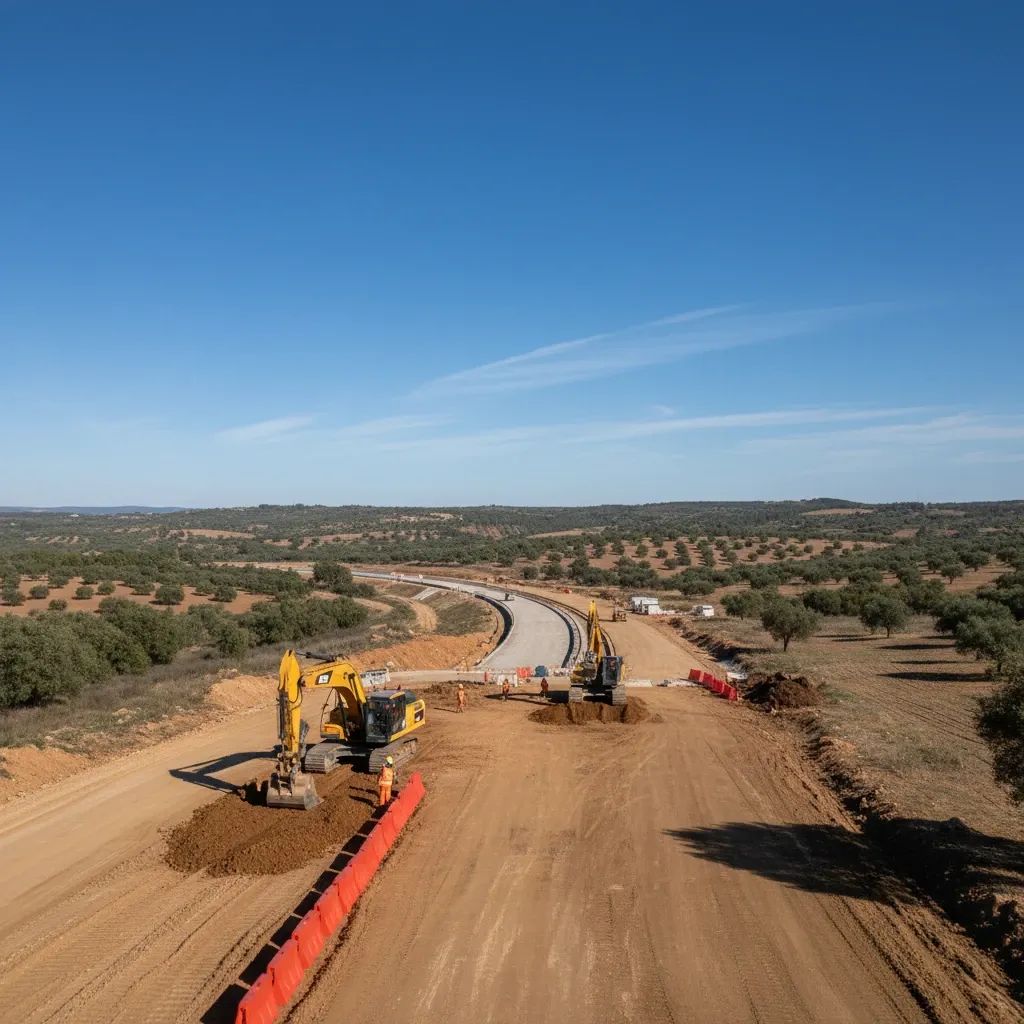
The Portugal Cabinet, through Prime Minister Luís Montenegro, has reaffirmed its commitment to connect the Alentejo district capitals of Beja, Évora, and Portalegre to the national motorway network—a long-overdue infrastructure push that aims to end decades of geographic and economic marginalization in the interior south.
Why This Matters:
• Active construction: The A2-Beja link is currently under construction, with a €2 billion national road package announced for the next three years.
• Study phase: Feasibility studies for Portalegre's connections to the A6 and A23 motorways are underway, with completion expected by 2028.
• Economic parity: The move is designed to lower logistics costs, attract investment, and reverse population exodus from the Alentejo interior.
The Commitment: All District Capitals on the Fast Lane
Speaking at the Centro de Ciência do Café in Campo Maior—where Grupo Nabeiro-Delta Cafés showcased a €20 M expansion of its Novadelta roastery—Montenegro outlined the government's roadmap. "The goal is to have all district capitals served and connected by motorway. It's a commitment the Economy Minister Manuel Castro Almeida assumed, and we will deliver it together," he stated.
The announcement comes as Infraestruturas de Portugal (IP), the state-owned infrastructure manager, accelerates work on several critical links. The A2-Beja connection is already in execution phase, while a March 2026 tender for the A26 study will finalize the 35-kilometer stretch that had been interrupted, including a new bypass around Ferreira do Alentejo. The Beja Municipal Council requested that IP launch the final execution project by the end of the first half of this year.
For Portalegre, the government authorized IP in February to advance technical designs for a high-speed road corridor—either a full motorway or motorway-standard route (a road built to motorway specifications without formal motorway classification)—linking the A23 and A6. This would provide both north-south and east-west connectivity for a capital that has been functionally isolated from Portugal's fast-lane infrastructure since the modern network was built.
What This Means for Residents and Businesses
For decades, the absence of direct motorway links to Beja, Évora, and Portalegre has inflated transport costs, deterred investors, and contributed to steady population drain from the Alentejo interior. Companies operating in these districts have long faced higher logistics expenses compared to competitors near Lisbon or Porto, forcing many to rely on slower secondary routes to manage budgets.
A toll exemption scheme for residents and businesses on sections of the A2 and A6 within the Alentejo provides some relief—welcome, but acknowledged by planners as insufficient without the physical infrastructure to match. The new motorway plan promises to change the equation by:
• Cutting travel times: Direct motorway access to Lisbon, Spain, and the Algarve will dramatically reduce journey durations. For example, current travel time from Beja to Lisbon via secondary roads can exceed four hours; a completed A2-Beja link would cut this to approximately two to two-and-a-half hours. Similarly, reaching the Spanish border from Portalegre currently requires navigating slower regional routes; a motorway connection via the A23 and A6 would reduce this journey from roughly three-and-a-half hours to under two hours.
• Lowering freight costs: Logistics operators estimate that motorway-standard links could reduce per-kilometer transport costs by 15-20%, making Alentejo firms more competitive.
• Enabling scale: The Novadelta expansion in Campo Maior, which will double daily production capacity to 200 tonnes, is a case study. The company's ambition to break into the global Top 10 coffee brands depends on reliable, rapid distribution to European markets.
The Numbers: Investment and Timeline
While no single figure has been attached to the Beja-Évora-Portalegre motorway package, the broader road modernization program involves €2 billion over three years, with industry estimates suggesting €4 billion would be needed to fully modernize Portugal's national motorway grid.
Specific allocations include:
• €88.5 M from the EU Recovery and Resilience Plan (PRR) for the 12.8-kilometer Évora Eastern Bypass (€54.9 M) and the IP8 upgrade between Ferreira do Alentejo and Beja (€33.6 M).
• €2.5 M for the Portalegre-Estremoz A23/A6 feasibility study, awarded in March with a 660-day execution window.
• €46 M for vegetation management across Portalegre, Évora, and Beja road networks through 2031—an operational expense that reflects IP's long-term commitment to the region.
The Connecting Europe Facility (CEF Transport), with a €25.8 billion 2021-2027 budget, is expected to co-finance portions of the work, though no explicit allocations have been disclosed for these routes yet.
Political and Fiscal Context
Montenegro framed the motorway pledge within a broader economic narrative. "We are betting on a more business-friendly tax policy, one that takes less in taxes to give companies greater availability" to raise wages and reinvest, he said. The government's strategy pairs infrastructure rollout with tax simplification and fiscal incentives aimed at interior regions.
The timing is deliberate. Global conflict-driven inflation has squeezed household budgets and corporate margins, and the government is pitching the motorway plan as a resilience measure. "The stronger we are in the future, the more resilient, the better prepared for adversity, the more we can face these oscillations without disrupting people's daily lives," Montenegro added.
The rhetoric echoes a longstanding critique: that Portugal's infrastructure spending has historically favored coastal corridors—Lisbon, Porto, the Algarve—leaving the interior to languish. The Alentejo, despite comprising nearly one-third of Portugal's landmass, has seen its population stagnate or shrink in nearly every census since the 1980s.
Current State of the A2, A6, and A23
The three motorways that will form the backbone of the new Alentejo grid are themselves in flux:
• A2 (Lisbon-Algarve): Tolls rose 50 cents in January 2026 to €23.80 for the full route. Concessionaire Brisa is investing €64 M this year in pavement upgrades, viaduct rehab, and electric vehicle charging stations. The A2-Beja link is the most advanced piece of the puzzle, already under construction.
• A6 (Lisbon-Spanish border at Caia): Tolls jumped 35 cents on the Marateca-Caia segment, now €15.40. The exemption for Alentejo residents partially offsets this toll increase. The A6 will anchor Portalegre's southern connection once studies are complete.
• A23 (Guarda-Algarve): Rehabilitation of overpasses is ongoing, and the IC31 project—a toll-free link to Spain's EX-A1 near Alcains—is set to launch construction in 2026, originally slated for 2031 completion but now being fast-tracked. The A23 will provide Portalegre's northern artery.
What the Data Doesn't Say—And What We Know About Évora
Notably, no firm completion dates have been announced for Évora's direct motorway link. The government's 2026 announcements focus most explicitly on Beja and Portalegre, where construction timelines and feasibility studies are underway. For Évora, the current committed infrastructure project is the Eastern Bypass (a dual-carriageway route that circles the city's eastern perimeter, easing through-traffic without creating a new motorway entrance).
This distinction matters for Évora residents and businesses. A bypass improves traffic flow for travelers passing through the city but doesn't provide the direct, high-speed entry and exit points that a full motorway connection would offer—meaning logistics companies and commuters still face longer routing times than residents of Beja or Portalegre will enjoy once their motorway links are complete. Évora, as the Alentejo's largest city by population and a UNESCO World Heritage site, has tourism and logistics demands that a bypass alone may not fully address. Whether a separate motorway connection for Évora is in the pipeline remains unclear; the government has not publicly detailed a timeline for this, and it remains a gap worth monitoring as projects advance.
The Broader Alentejo Strategy
The motorway commitment dovetails with other regional initiatives under the ALT2030 program, which funds cultural, social, and economic projects across the Alentejo. The government is also advancing agricultural and water infrastructure investments, recognizing that the region's economy hinges on agribusiness, cork, olive oil, wine, and increasingly, industrial food production like the Delta Cafés operation.
The challenge is execution. Portugal's track record on interior infrastructure is mixed—projects announced with fanfare have often faced delays, budget overruns, or outright cancellation when political winds shift. The A26, for instance, was partially built and then abandoned before the current government revived it.
For residents of Beja, Évora, and Portalegre, the proof will be in the pavement. The studies are underway, the contracts are being signed, and the bulldozers are moving—but the ultimate test is whether, in five years, a driver in Portalegre can reach Lisbon or Madrid in under two hours on a full motorway. Until then, the commitment remains just that: a promise on paper, not yet a road under wheels.


