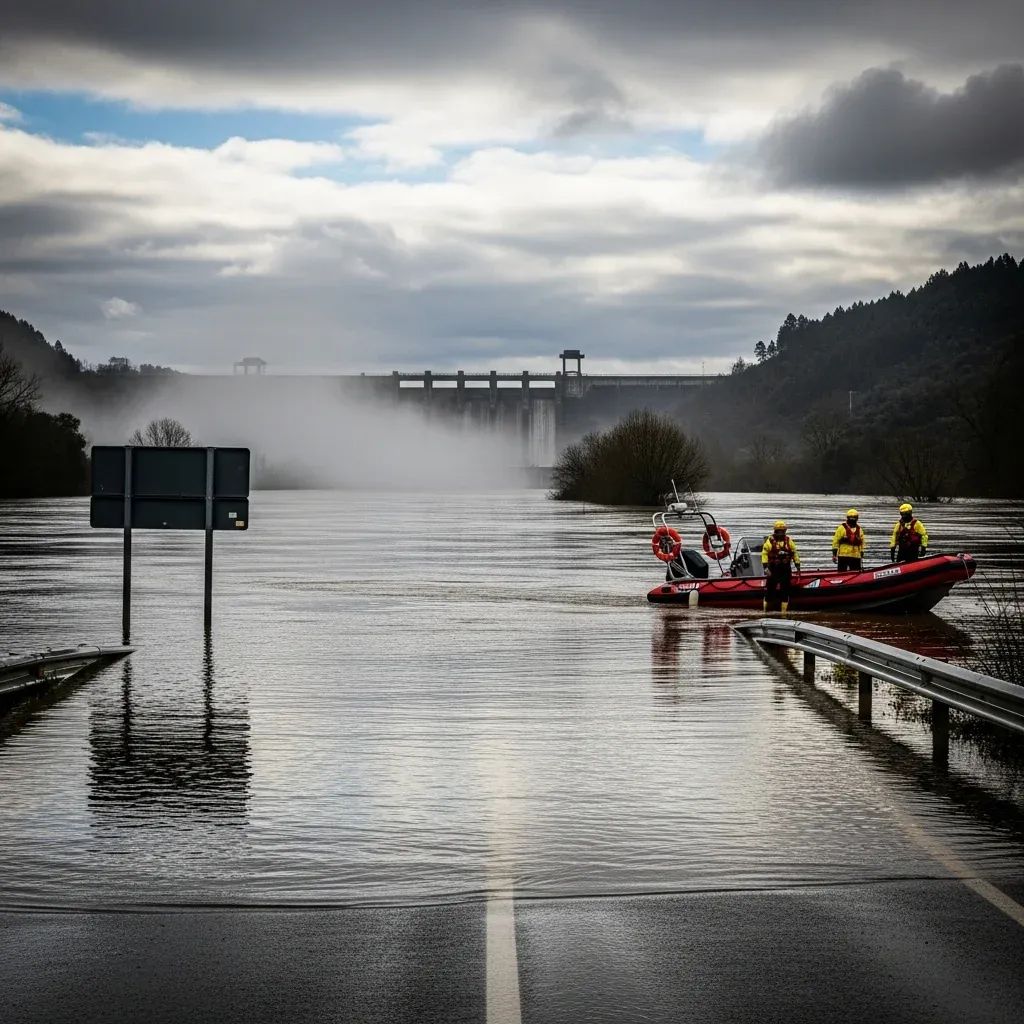
The early hours felt almost tranquil across mainland Portugal, but emergency teams remind citizens that the storm-season roller-coaster is not over yet. Fires were not the issue; instead, professionals spent the night removing branches, redirecting water and double-checking river gauges after a week dominated by depression “Kristin”.
Key overnight takeaways
• 22 minor call-outs registered between 00:00 and 07:00 — a dramatic contrast with the more than 2,000 weather-related incidents logged 24 h earlier.
• Most interventions involved fallen trees, loose roof tiles, and roadway clearance rather than structural collapses.
• ANEPC’s command centre kept 18 000 operatives on standby, but only regional brigades in Leiria, Coimbra, and Oeste needed reinforcements.
• National forecasts from the IPMA show the worst winds have shifted eastward; nonetheless, urban flooding, particularly near the Mondego and Sado, remains a moderate risk.
Calm dawn after violent nights
For residents who fought through power cuts and blocked roads earlier in the week, today’s lull offers a welcome pause. Meteorologists, however, urge caution. The same Atlantic conveyor belt that delivered record 178 km/h gusts to Monte Real on Wednesday has only paused, not disappeared. A small change in trajectory could again put Portugal in the path of another secondary depression.
What kept firefighters busy overnight?
Although no large-scale catastrophe unfolded, local corps still tackled a string of low-intensity but time-consuming tasks:
Clearing debris: branches and signage littered national roads EN1 and EN109, forcing short traffic stoppages.
Draining water: saturated soils in Pombal produced minor landslips, prompting crews to divert run-off away from homes.
Securing rooftops: gusts peeled tiles from older buildings in Caldas da Rainha, a recurrent issue during Atlantic lows.
Assisting motorists: three weather-related spin-outs on the A 17 were resolved without injuries.
Kristin’s numerical footprint
In the space of 48 h this week, “Kristin” generated:
• 5,400 emergency tickets by 22:00 Wednesday
• A corrected 3,300 final tally after duplicate reports were removed
• Peak workload in the West, Leiria, and Coimbra districts accounting for 64 % of all calls
• 8,160 cumulative events between 27 and 29 January when previous lows “Joseph” and “Ingrid” overlapped
Why the sudden lull?
Three factors explain the respite:
• The frontal core passed northeast into Spain, leaving Portugal in its subsident (dry) sector.
• A brief warm spell — maximums around 17 °C in Lisbon — stabilised lower layers, cutting convective bursts.
• Overnight tides were neap, lowering the chance of marine overtopping along the Costa de Prata.
Rivers still under watch
Hydrologists monitoring the Mondego near Montemor-o-Velho and the Sado at Alcácer report levels below alert thresholds, yet rain that fell upstream on Wednesday could still arrive this weekend. Authorities have pre-positioned portable dikes, pumps and sandbags in flood-prone hamlets such as Açudes, Maiorca and Mourisca.
Government response and next steps
The Council of Ministers’ earlier declaration of a state of calamity for 28 January–1 February remains in force. This legal status:
• Accelerates public-works procurement
• Activates emergency housing funds for families whose roofs collapsed
• Allows expedited overtime payments to volunteer firefighters
Interior Minister Margarida Tomé confirmed that requests for military support have been signed but “only as a precaution”.
How to stay prepared
Even with blue sky overhead, Protección Civil advises:
• Keep drainage grates near homes clear
• Store flashlights and charge backup batteries
• Check that loose antennae, awnings and garden furniture are secured
• Avoid parking under large eucalyptus or plane trees, which often uproot in saturated soils
At a glance: storm season scorecard
January’s final tally shows why the country cannot let its guard down:
• Joseph – 490 events on 27 Jan
• Ingrid – 231 events on 23 Jan
• Kristin – 3,300 validated events on 28–29 JanEven if the atmosphere grants a quiet weekend, forecasters remind us that February traditionally brings new Atlantic lows. Vigilância, not alarm, is the watchword — and for now, Portugal enjoys a rare morning when the incident map is almost blank.