

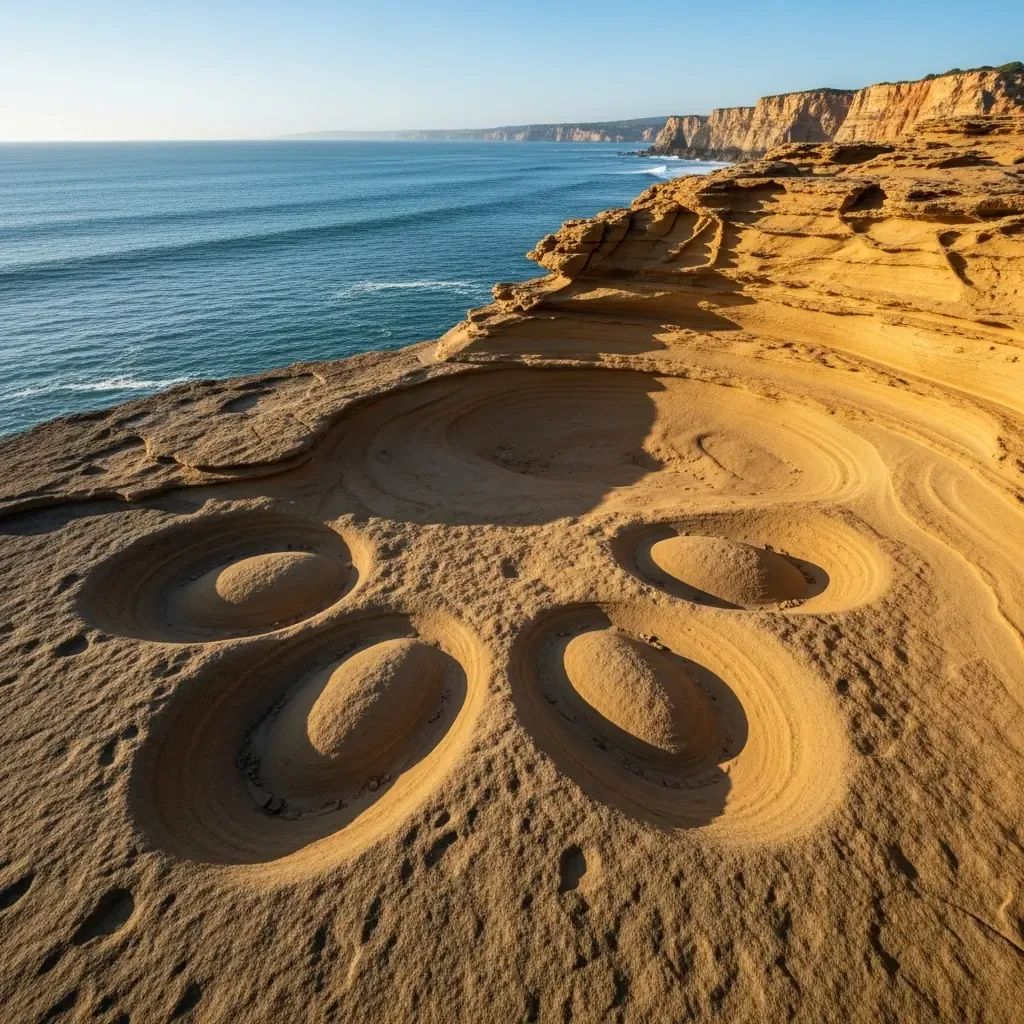
A gusty stroll along the cliffs of Santa Cruz has unexpectedly given Portugal another piece of its Jurassic puzzle: a tightly packed clutch of 150-million-year-old dinosaur eggs that appears to belong to a small carnivorous predator. The find, made by a local researcher as part of routine site monitoring, is already being hailed as the most complete in-situ dinosaur nest ever recorded on the country’s Atlantic rim.
Snapshot
• Location: coastal bluffs of Santa Cruz, Torres Vedras
• Age: roughly 150 Ma, late Jurassic
• Likely parent: meat-eating theropod
• Sediment: rare granular sandstone, hinting at an ancient riverbank
• Condition: eggs appear semiburied, shells mostly intact, little lateral dispersion
• Next step: high-resolution CT scans to search for embryos
An Unexpected Find Above the Atlantic
Standing on a ledge only a few metres from modern surfing spots, geologist Carlos Natário noticed a peculiar oval texture emerging from weathered sandstone. Further clearing revealed several thin-shelled ovoids arranged in a gentle arc—a pattern too orderly for random debris. Specialists from the Sociedade de História Natural de Torres Vedras (SHN) quickly cordoned off the outcrop, confirming that the eggs had never been moved by waves or landslides. The discovery underscores how Portugal’s west coast still hides pockets of deep time directly beneath popular holiday trails.
Why Jurassic Eggs Matter for Portugal’s Scientific Map
Portugal already enjoys global attention for the Lourinhã Formation, a sedimentary sequence often compared to the Morrison beds in the US. Yet intact nests are scarce worldwide, and Jurassic carnivore eggs are rarer still. By slotting neatly into that gap, the Santa Cruz find could elevate the country’s status from good place for bones to primary reference for dinosaur reproduction. For local universities and start-ups working on 3-D fossil modelling, that means new funding streams and fresh collaborations with museums in Denver, Munich and Tokyo.
Inside the Nest: What the Fossils Already Reveal
Preliminary microscope work shows a high-porosity shell—a trait that lets oxygen reach an embryo buried under damp sand. That same porosity is giving SHN researchers clues about the thermal strategy of the ancient parent, suggesting that it likely covered the clutch with a thin sediment blanket instead of leaving it fully exposed. The shells also curve inward, implying that most hatchlings successfully broke free before the nest was entombed by silt. Early measurements point to eggs no bigger than a large grapefruit, hinting at an adult roughly the size of today’s smaller ostriches.
From Cliffs to CT Scanners: Next Steps in the Lab
Within days, technicians encased the entire block in plaster jackets for a cautious trip to the SHN laboratory. There, micro-CT imaging—the same technology used in Lisbon’s oncology units—is scheduled to run slice by slice, creating a sub-millimetre 3-D model of each egg. Any preserved embryo would offer unprecedented data on skeletal growth, muscle attachment and even potential DNA-binding proteins. Post-scan, a digital replica will be released under an open-access licence, letting schools from Porto to Faro tour the interior of a Jurassic nursery in virtual reality.
How the West Portuguese Coast Became a Jurassic Hotspot
Geologically, Torres Vedras sits inside the Lusitanian Basin, a stretch of rifted crust that accumulated thick stacks of river-delta sediments as Pangea split. Those layers, collectively known as the Lourinhã Group, were laid down between 155 Ma and 145 Ma when conifer swamps and broad sandbars criss-crossed what is now the Oeste shoreline. Shifting coastlines repeatedly buried animal tracks, carcasses and, in this case, nests set on floodplain margins. Modern cliff erosion acts like a slow-motion dig, peeling back strata and pushing fossils literally into daylight.
Iberian Egg Hunts: How Spain’s Titanosaurs Differ
Across the border, finds in Huesca and Guadalajara showcase dozens of titanosaur eggs from the Late Cretaceous—almost 80 million years younger and laid by giant herbivores. Those Spanish localities preserve basketball-sized spheres, loosely scattered over large nesting grounds. By contrast, the Portuguese clutch is tiny, neatly organised and tied to a meat-eater, offering a complementary but distinctly different behavioural snapshot of Iberian dinosaurs.
What It Means for Tourism, Schools and Local Economy
Municipal officials are already drafting a Geo-Trail linking Santa Cruz to neighbouring sites in Lourinhã, complete with augmented-reality waypoints and bilingual signage. Local cafés anticipate a bump in winter foot traffic, while primary teachers in the district plan to integrate the nest into STEM curricula, illustrating concepts of evolution, climate and deep time with a ready-made Portuguese example.
Key Insights at a Glance
The Santa Cruz nest could become Europe’s reference specimen for Jurassic predator reproduction.
Granular sandstone adds a rare environment to the global catalogue of dinosaur nursery habitats.
Open-access 3-D scans will let Portuguese students explore the fossils in virtual classrooms.
Combined with Spanish Cretaceous finds, Iberia now offers a full 80-million-year timeline of dinosaur egg evolution.


